Updated October 2026
A dead tree in Tampa should come down soon: dead wood dries out and turns brittle, so limbs drop without wind and the trunk gets harder to rig the longer it stands. Florida law lets a homeowner remove a dangerous tree without a local permit when an ISA-certified arborist or licensed landscape architect documents the risk.
Why dead trees are a different job
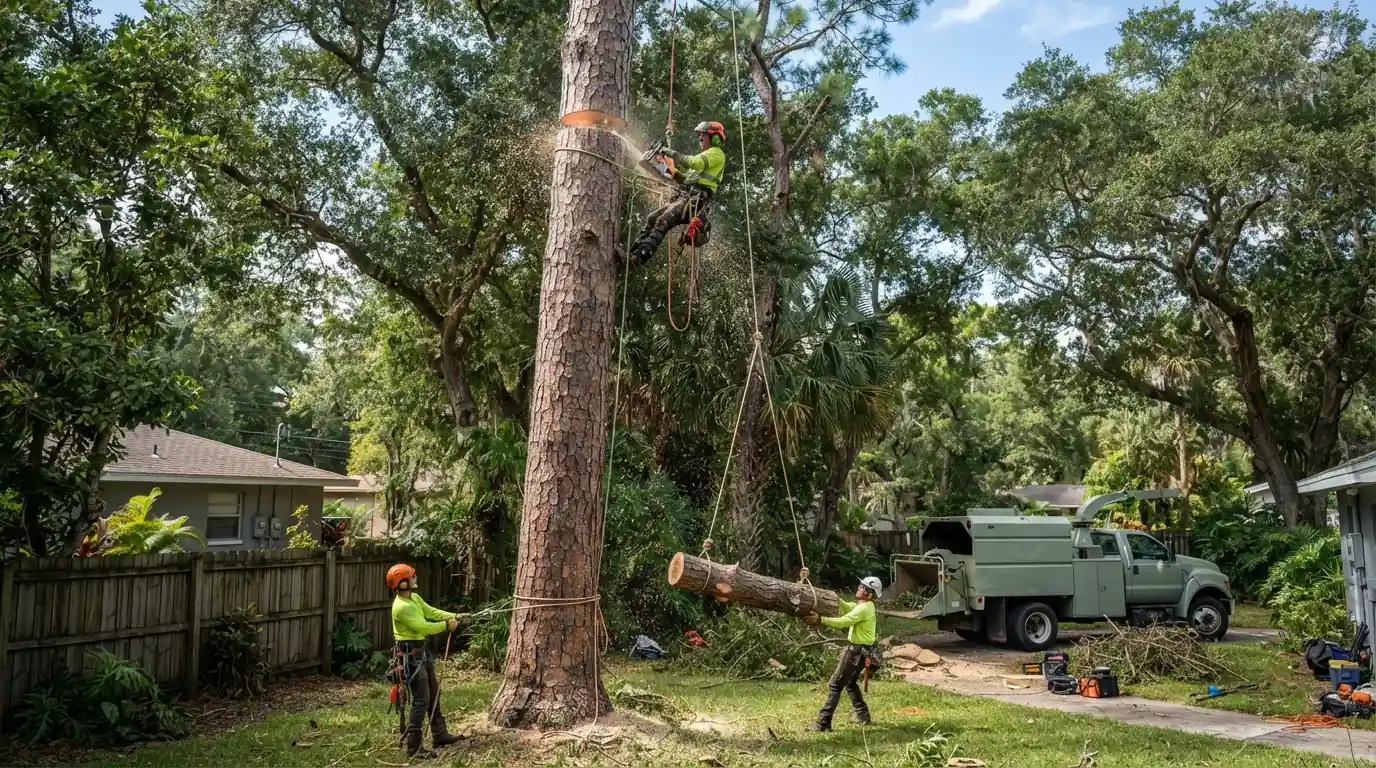
On a living tree a climber ties into strong limbs and lowers the rest on ropes. On a dead tree those limbs can snap under a climber's weight, so the work shifts to a bucket truck or a crane that holds each piece before it is cut.
Speed matters too. A dead oak or pine that is sound this spring can be brittle by next storm season.
What dead tree removal costs
Dead trees are priced by size, condition and what they stand over.
- Height and trunkBigger trees, more cuts.
- How brittleAdvanced decay needs a bucket or crane.
- What is underneathRoofs and cages mean small sections.
- Crane timeHeavy dead trunks lifted clear.
- PaperworkPermit or hazard documentation.
- Stump and haulSeparate lines.
Typical planning range: $800 to $3,500 per tree for most residential removals in Florida; small trees under 30 feet from about $200 with easy access; very large, hazardous or crane-only trees over 80 feet $5,000 to $15,000+. Market figures, not a quote from us.
Standing dead tree removal
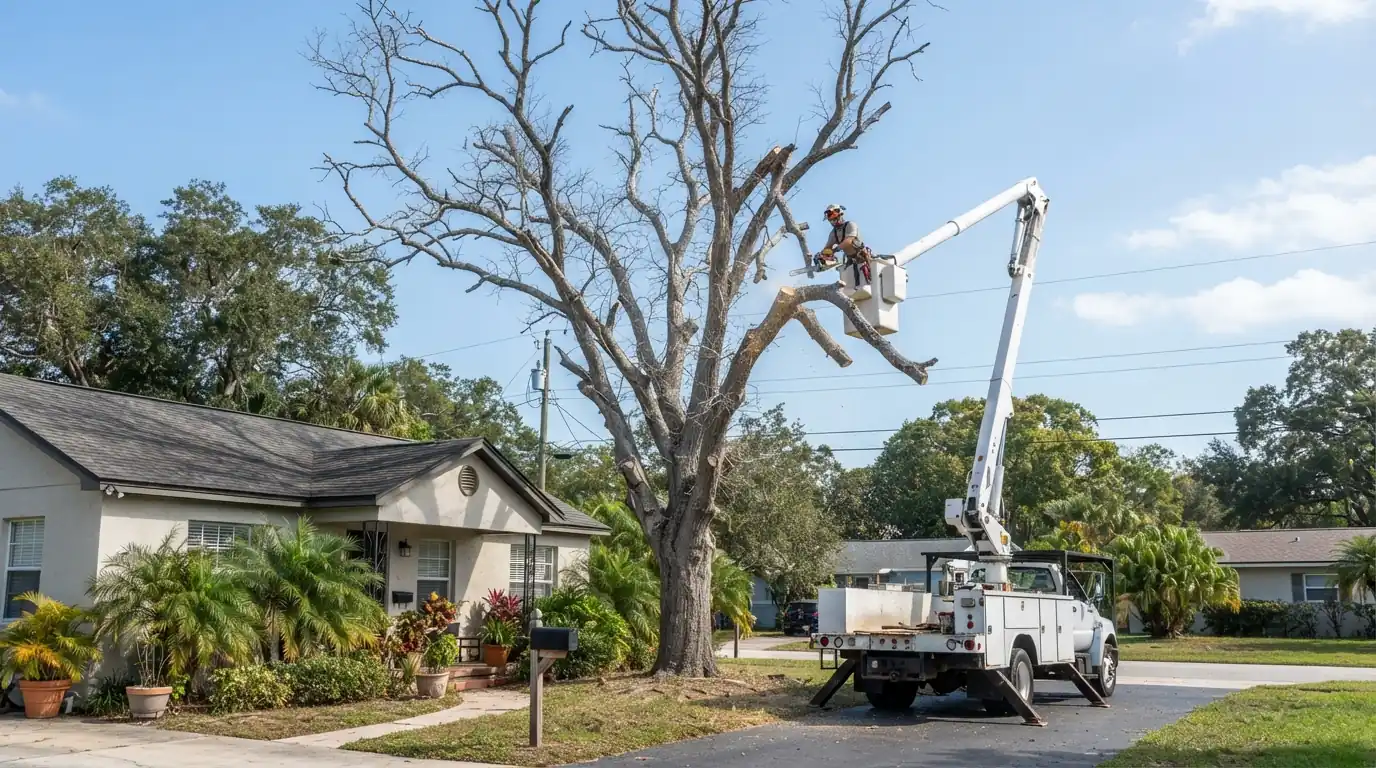
A standing dead tree has no leaves to catch wind, but its wood is drying and weakening every week. Twigs go first, then small limbs, then large limbs, often on calm days. We do not climb into a dead crown. The crew works from a bucket truck or lets a crane hold the tree, taking the limbs off in pieces before the trunk comes down in sections or is felled where there is room. The sooner it is scheduled, the more options there are.
Typical planning range: $800 to $3,500 per tree for most residential removals in Florida; small trees under 30 feet from about $200 with easy access; very large, hazardous or crane-only trees over 80 feet $5,000 to $15,000+. Market figures, not a quote from us.
Dead trees over houses and pools
Dead trees over roofs, pool cages and fences are the most urgent calls we get, short of a tree already on the house. Each piece has to be controlled all the way down, which is hard when the wood itself may break at the tie-in point. We use the bucket truck to reach over the structure and cut small, or bring in a crane to lift heavy sections clear. Pool cages and lanais are covered or worked around piece by piece so nothing lands on the screen.
Hazard documentation and permits
Florida Statute 163.045 lets a residential property owner remove a tree without a local permit when documentation from an ISA-certified arborist or a Florida-licensed landscape architect shows it poses an unacceptable risk. Tampa recognizes the statute but wants that assessment on site during the work. Temple Terrace regulates standing dead trees 12 inches or more across on single-family lots. We tell you which path applies and make sure the paperwork is ready before the crew arrives.
Dead tree wood and stump cleanup
Dead wood is not always clean wood. Pines killed by bark beetles and bay trees killed by laurel wilt can carry pests to the trees around them, so that wood is chipped or hauled rather than stacked as firewood beside healthy trees. We grind the stump when you want the spot cleared, and we look at the neighboring trees before we leave, because whatever killed one tree may already be working on the next one, and catching it early can save that tree.
Taking a dead tree down yourself
| Question | Doing it yourself | Our crew |
|---|---|---|
| Small dead sapling | Fine with a saw and a clear fall zone. | Quicker, with the stump ground. |
| Large dead tree near a house | Brittle wood breaks where you do not expect. | Bucket or crane, never a climb into dead wood. |
Dead tree rules around Tampa
Florida's hazard-tree statute lets a homeowner skip the local permit with an ISA-certified arborist's or licensed landscape architect's documentation, and Tampa recognizes it as long as that assessment is on site during the work. Temple Terrace goes further and regulates standing dead trees 12 inches or more across on single-family lots. Dead swamp bays from laurel wilt along the Hillsborough River floodplain are another common call.
How a dead tree removal runs
- 1Call
Tell us the tree and what is under it.
- 2Look
Decay, lean and drop zone checked.
- 3Paperwork
Permit or hazard documentation lined up.
- 4Set up
Bucket truck or crane positioned.
- 5Limbs off
Small pieces, controlled all the way down.
- 6Trunk
Sectioned or felled where there is room.
- 7Clean up
Wood handled, stump ground if chosen.
Signs a tree is dead or nearly there
- No new leaves
An evergreen oak bare in late spring.
- Bark falling away
Loose or missing bark on the trunk.
- Brittle twigs
Small branches snap instead of bend.
- No green under the bark
A light scratch shows dry brown wood.
- Fungus on the trunk
Conks or mushrooms at the base.
Dead tree questions
Soon. Dead wood gets more brittle every month.
Often, unless hazard documentation under state law applies.
Dead limbs can snap under a climber's weight.
Usually not; it needs a bucket truck or crane.
Not from beetle-killed pines or laurel wilt bays near healthy trees.
No new leaves, loose bark and brittle twigs are the main signs.
Yes, before we leave.
Other removal work
From our guides: Signs a Tampa Tree Is Dying or Dangerous