Updated October 2026
Most Tampa palms come down in sections: a climber or bucket takes the crown off first, then the trunk is cut into rounds and lowered. The root ball is a dense fibrous mat with no taproot, so it is ground out afterwards. Queen palms need no permit in unincorporated Hillsborough; other palms depend on where you live.
Why palms come out differently from trees
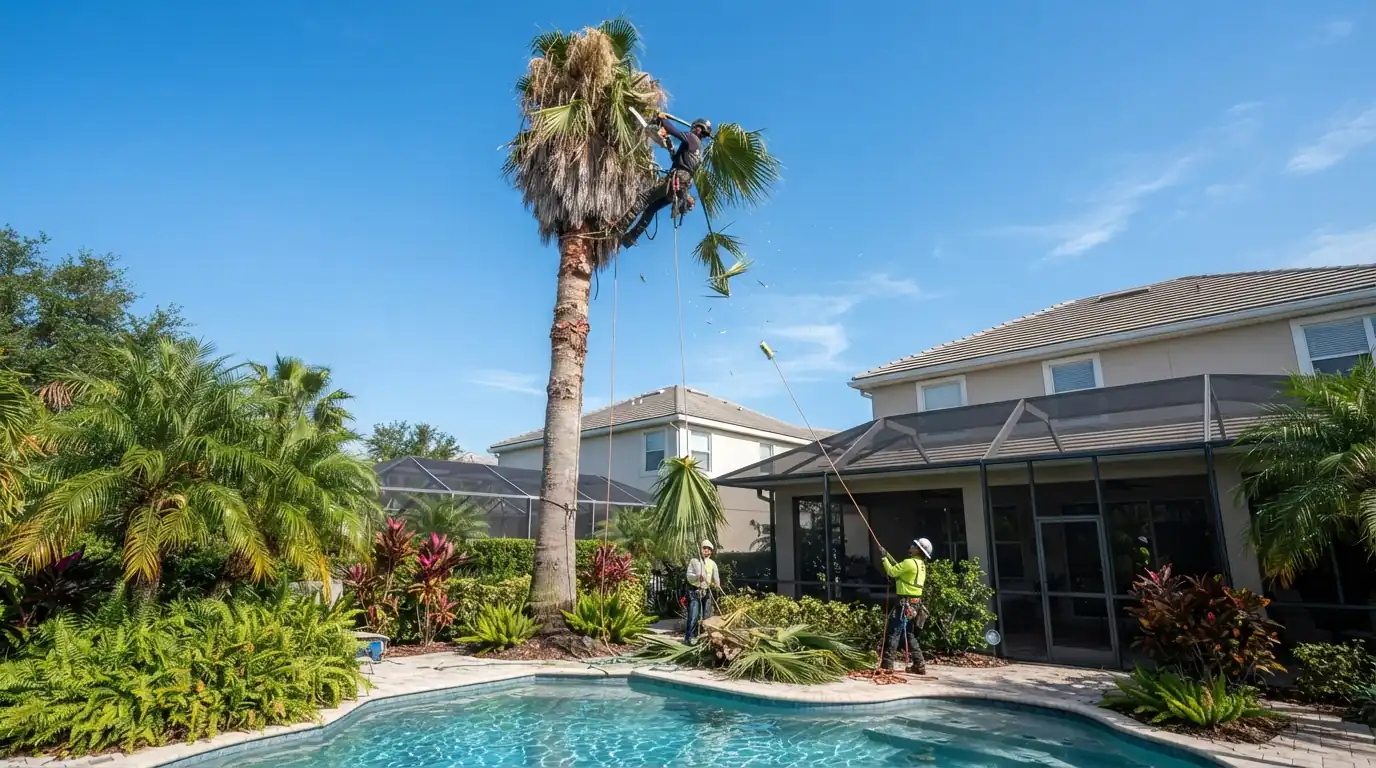
A palm has no branches to rig from and no hardwood to hold a rope, so the method is simple and the care is in the details: the crown comes off first so nothing heavy swings, then the trunk comes down in rounds short enough to handle.
The part people forget is below ground. A palm root ball does not rot away quickly, and it has to be ground before new sod or a bed will take.
What a Tampa palm removal costs
Palms are priced by height, access and what happens to the root ball.
- HeightTall palms need a bucket or climber.
- AccessSide yards mean hand carrying.
- HazardsRoofs, pools and lines add time.
- SpeciesBig trunks weigh far more.
- Number of palmsGroups cost less per palm.
- Root ballGrinding is a separate line.
Sabal and cabbage palm removal
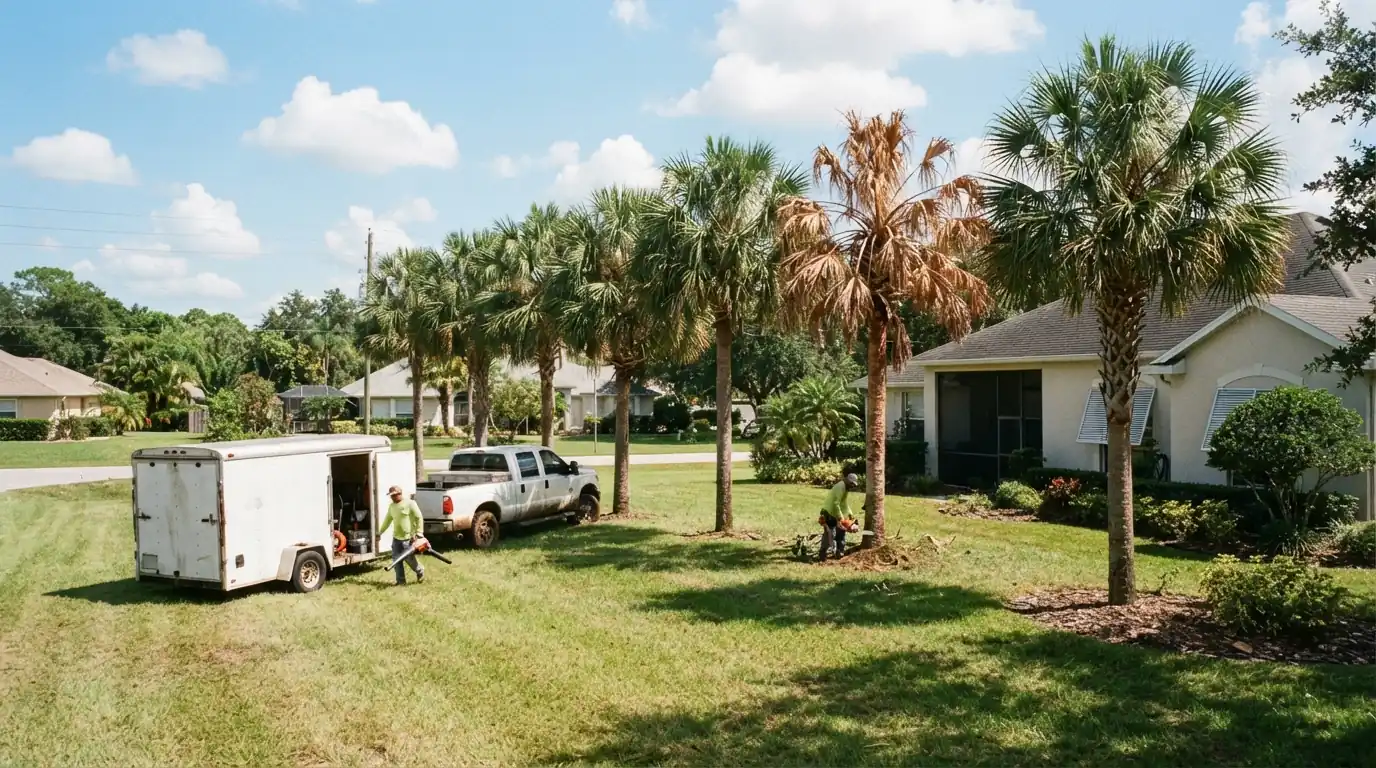
Sabals, also called cabbage palms, are Florida's native palm and the most common one we remove. Healthy sabals rarely need to come out, so the usual reasons are a bronzing or collapsing crown, a trunk growing into a foundation or pool deck, or a new driveway. In open yards the job is quick: the head comes off, the trunk is cut into rounds, and a trailer takes it away. We also check the neighbors, since a problem in one crown can show up in the next.
Queen palm removal
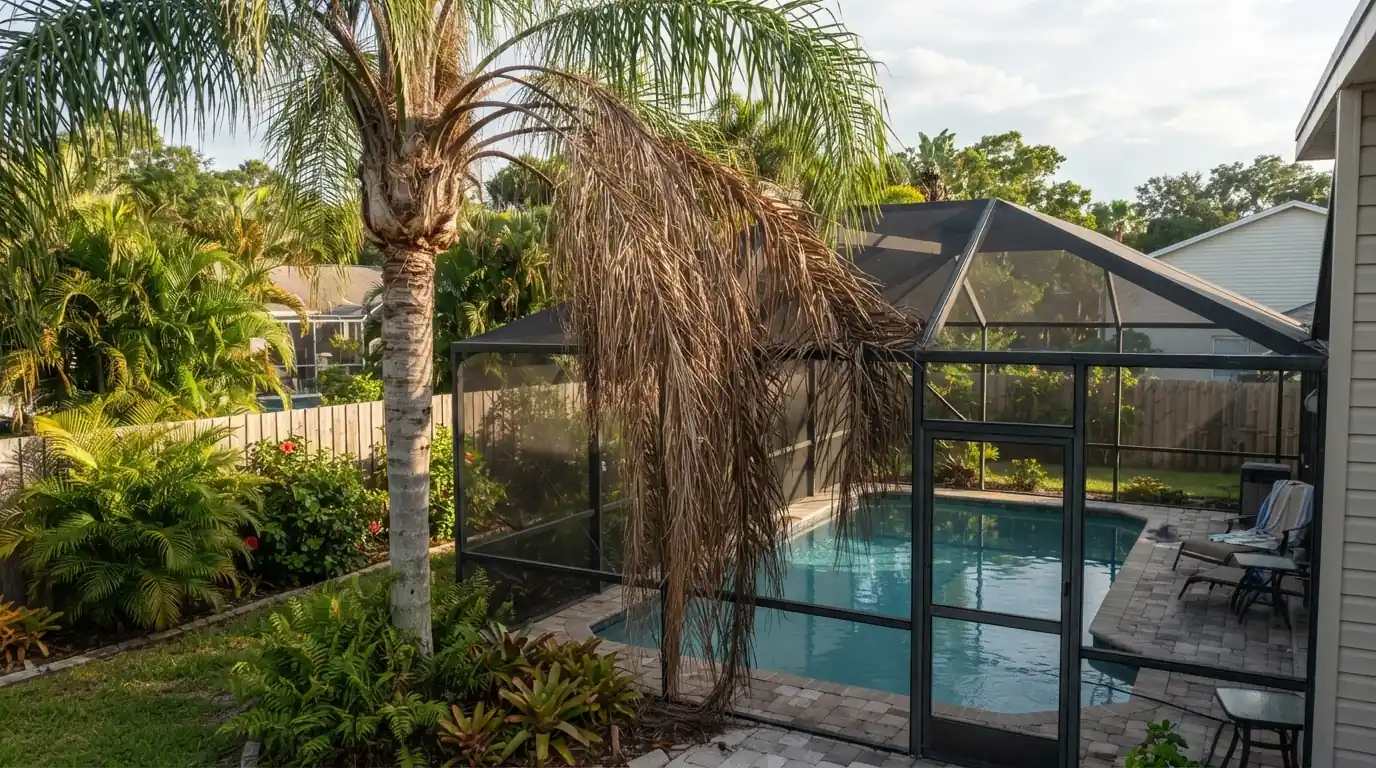
Queen palms are popular, fast and short-lived. They drop fronds and heavy fruit stalks all year, lean over pools and lanais, and go downhill quickly when they are underfed or damaged by cold. Many owners replace them with something sturdier. In unincorporated Hillsborough County the queen palm is on the exempt list, so no removal permit is needed, and Temple Terrace exempts it too. We take it down in sections and grind the stump so the next palm can go in.
Washingtonia and tall palm removal
Tall washingtonias and other big palms are where access and height matter. A climber on spikes or a bucket truck removes the crown in pieces, then the trunk is taken down in lengths that will not bounce into the house or the pool cage when they land. Where there is no room at all, the trunk is lowered on a rope or lifted by crane. Tall palms near power lines wait until the utility has made the line safe, and nothing is cut until it has.
Typical planning range: $300 to $1,500 for most palm removals in Tampa; short sabals and clumping palms at the bottom, tall washingtonias and Canary Island dates at the top, crane jobs above it. Market figures, not a quote from us.
Palm root ball grinding
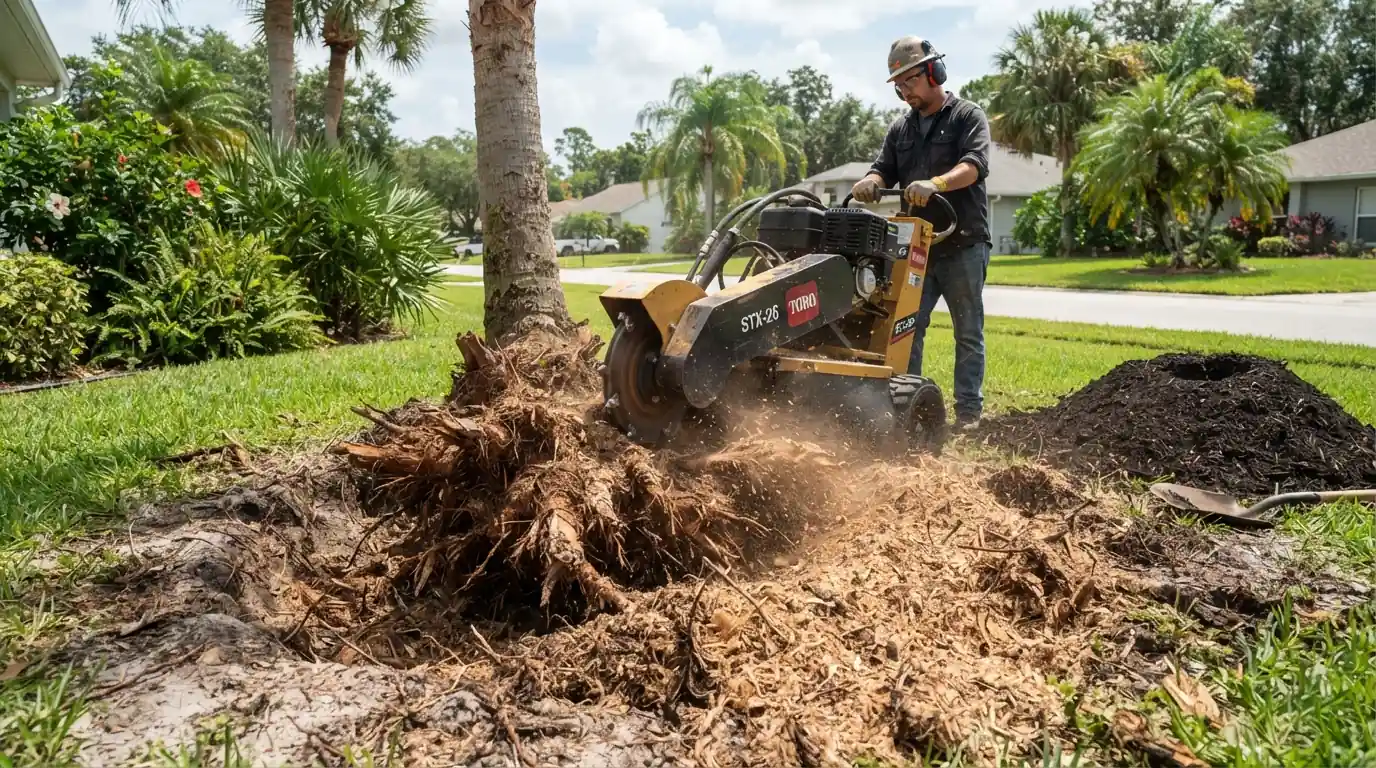
The root ball of a palm is a dense, fibrous mat with no taproot, and it grinds slower than a hardwood stump. We grind it well below grade, clear out the fibers, and leave clean soil so sod, a bed or a new palm can go straight in. Planting in the same hole without grinding tends to leave a soft, sinking patch where the old mat breaks down. Grinding is quoted on its own line, so you can decide whether you need it now or later.
Typical planning range: $100 to $300 for most palm stumps in Florida. Market figures, not a quote from us.
What a palm removal from us includes
- Crown taken off first, nothing swung over the roof
- Trunk cut into rounds and lowered or lifted
- Fronds, boots and rounds hauled away
- Root ball ground below grade when you want it
- Permit checked for your city or county
- Neighboring palms looked at for the same problem
Cutting a palm down yourself
| Question | Doing it yourself | Our crew |
|---|---|---|
| Short sabal in an open yard | Possible with the right saw and a clear fall zone. | Quicker, and the root ball is ground too. |
| Tall palm near a roof or pool | Crown weight is hard to control from a ladder. | Crown off first, trunk lowered in rounds. |
What palm removal looks like around Tampa
Palm removal changes with the neighborhood. Inland lots in Brandon, Riverview and Lutz carry mostly sabal palms in open yards, the simplest ground-crew removals of all. Older South Tampa lots are the opposite: narrow side yards and mature canopy overhead mean every round is carried out by hand. In Carrollwood and Town 'n' Country, bronzing sabal crowns are one of the most common reasons we get the call.
How a palm removal runs
- 1Call
Tell us the palm type, height and what is below it.
- 2Look and price
We check access, lines and the permit rule.
- 3Crown off
Fronds and the head come down first.
- 4Trunk
Cut into rounds and lowered or dropped safely.
- 5Haul
Rounds and fronds loaded out.
- 6Grind
Root ball ground if you chose it.
- 7Rake
Chips cleared and soil left level.
Palm removal questions
It depends on the city or county. Queen palms are exempt in unincorporated Hillsborough and Temple Terrace; we check the rest.
Usually not once the spear leaf dies. We look at it before recommending removal.
Yes, as its own line. It needs grinding before replanting.
Yes, once the root ball is ground and the fibers are cleared.
Most single palms take a few hours, including cleanup.
Sometimes. Healthy smaller palms can be transplanted.
Yes. Each stem is cut and the clump ground out.
More removal work
From our guides: How Often Palms Need Trimming in Tampa, FL