Updated October 2026
Vine and moss removal clears climbing vines from trunks and canopies and thins heavy Spanish moss or ball moss from standing trees. Vines are the bigger problem: they shade leaves, add wind load and hide the trunk. Spanish moss and ball moss are epiphytes that do not feed on the tree, so thinning them is mostly about weight, light and appearance.
Vines and moss are not the same problem
Vines climb the tree and compete with it for light, and some wrap tightly enough to damage bark. Moss hangs from the branches and simply uses the tree for support.
So vines are cut at the base and pulled from the canopy where it is safe, while moss is thinned only where it is heavy or blocking light.
Vine removal from trees
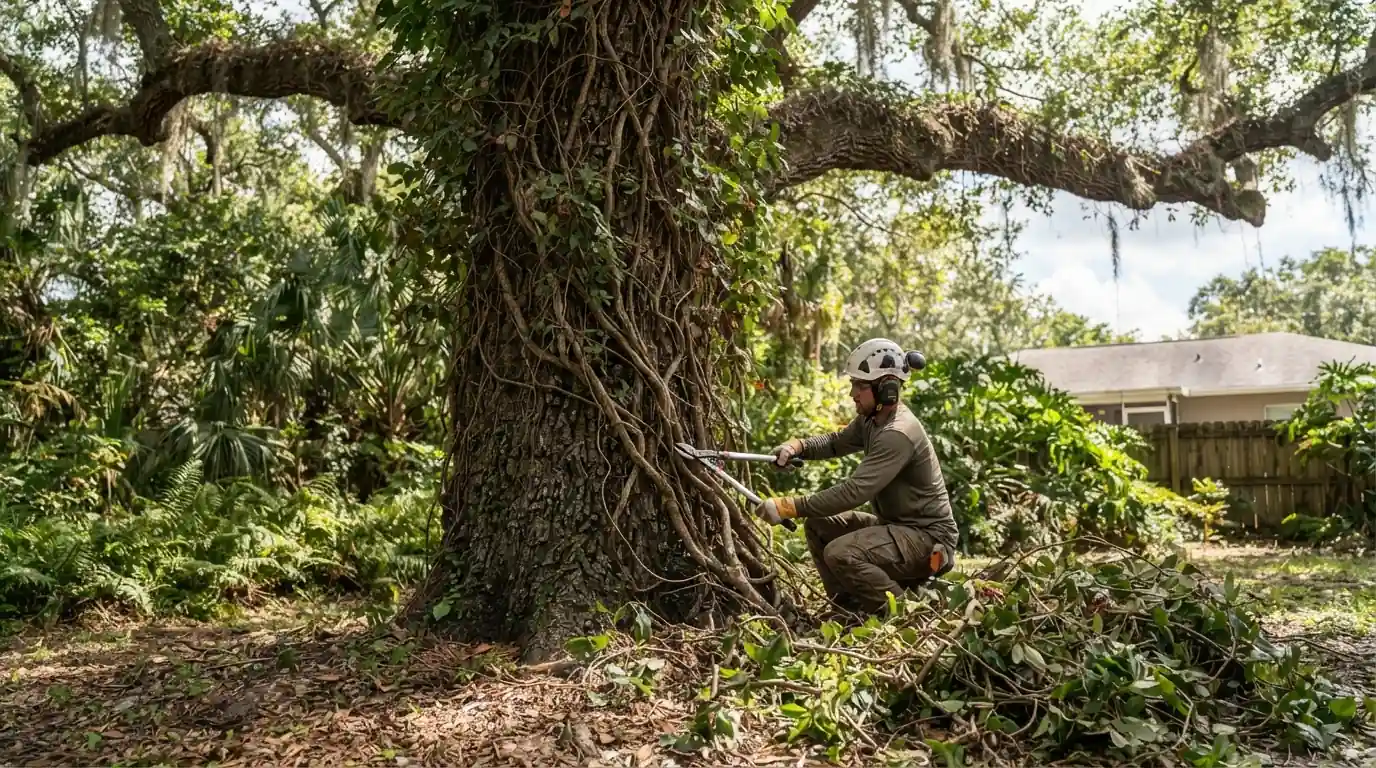
Vines like grapevine, Virginia creeper, poison ivy and invasive climbers can cover a trunk and climb into the crown within a few seasons. We cut each vine at the base so the upper growth dies back, then pull what can safely come down from the canopy without tearing bark or breaking branches. Vines that wrap around branches are cut in sections rather than yanked. The roots are cut back from the trunk flare so we can see the base of the tree again.
Spanish moss thinning
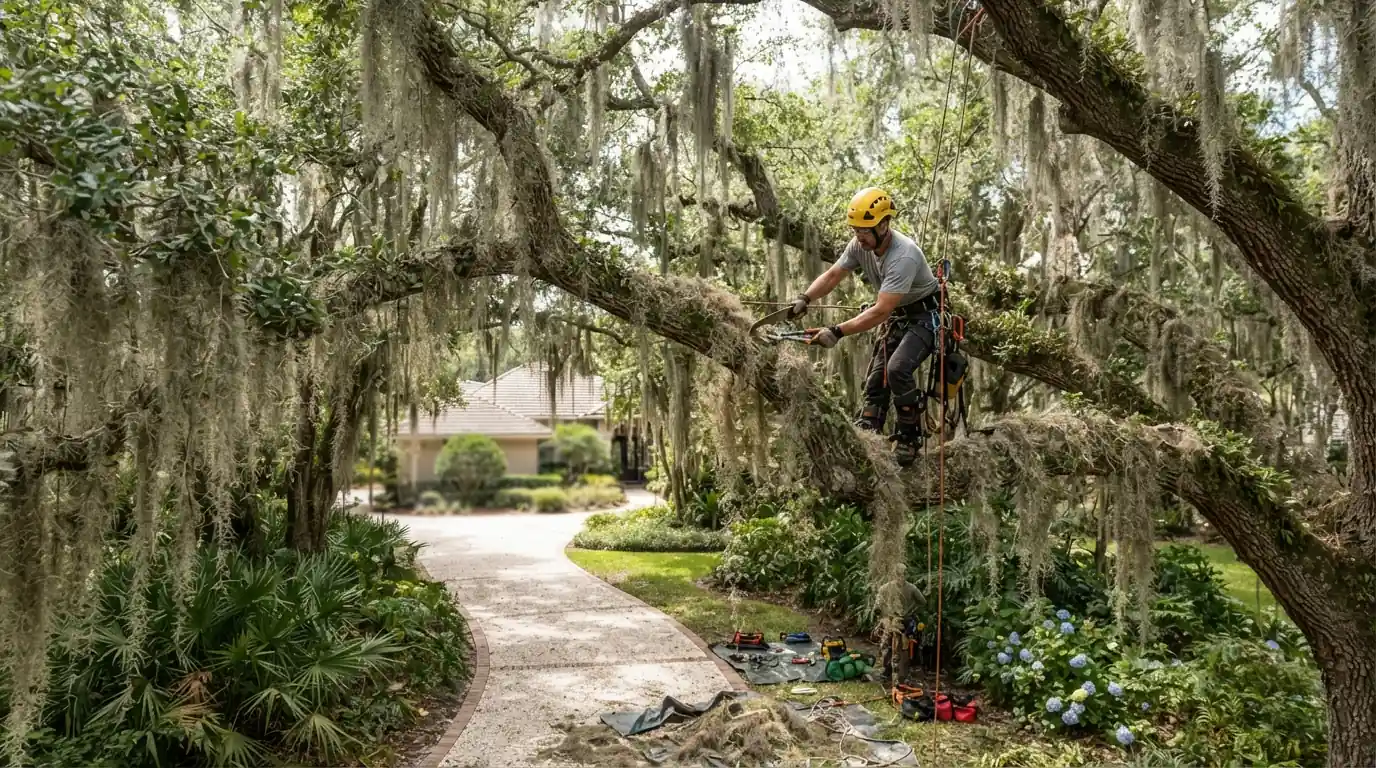
Spanish moss is an epiphyte: it hangs from branches and gets its water and nutrients from the air, not from the tree. It does not kill trees, and a light drape is part of what makes a Tampa live oak look like one. Heavy mats on weakened or thin limbs can add weight when soaked with rain, and they can shade inner leaves. We thin the heaviest loads by hand from a climb or bucket, and leave the rest where it belongs.
Ball moss removal
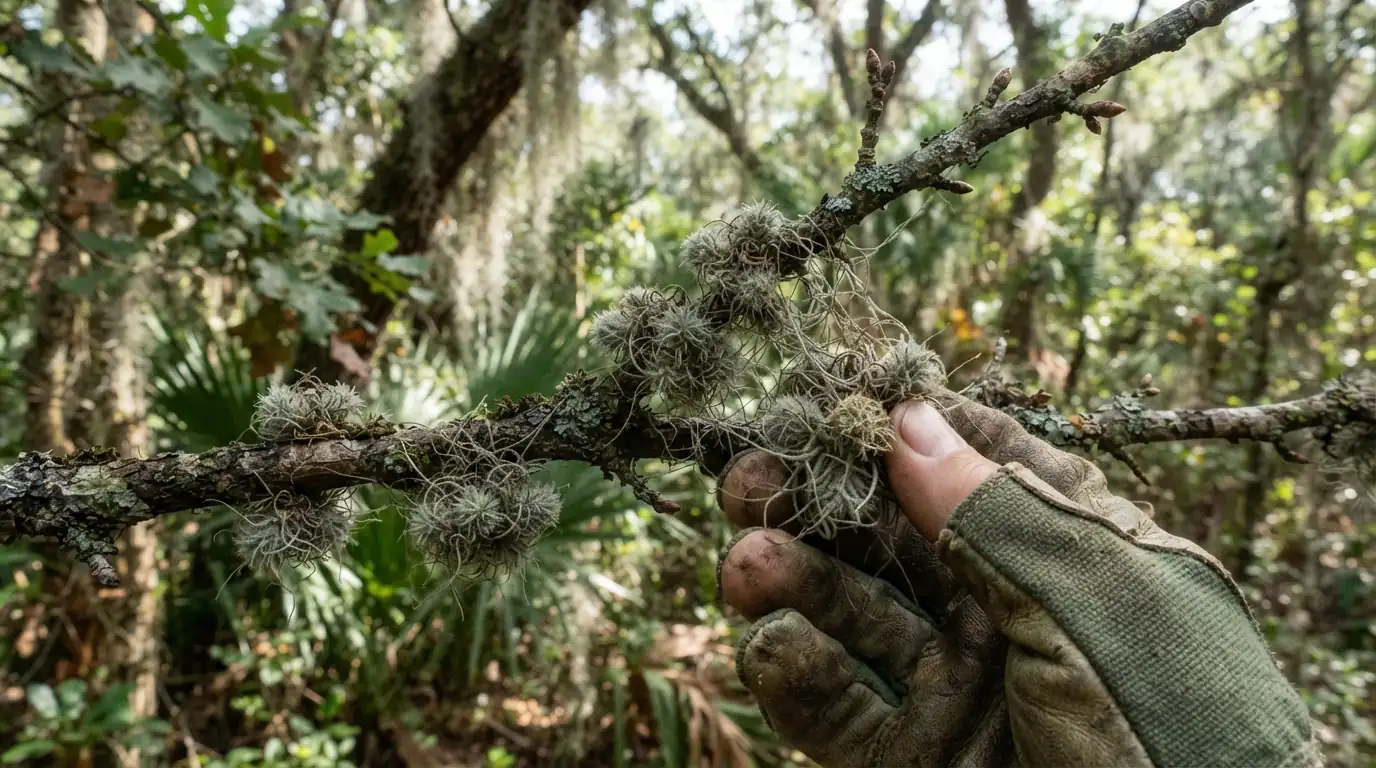
Ball moss is the small gray tufts that collect on inner branches, especially on oaks. It is often blamed for dying branches, but it is usually a sign of shade and slow growth inside the crown rather than the cause. Removing it is mostly cosmetic, and we say so. When branches carrying ball moss are dead, we remove the dead wood itself, and a crown thinning that lets more light inside naturally reduces how much ball moss comes back afterwards, without any spraying.
Invasive vine control on fences and trees
Vines that start on fences, sheds and hedges usually end up in the nearest tree. Clearing the tree without dealing with the source means it is covered again next year. We cut vines back along the fence line and at the base of nearby trees, remove the root crowns where we can reach them, and come back for regrowth when it is needed. Poison ivy is cut and bagged, never chipped or burned, and our crews wear full protection throughout.
Vines and moss on Tampa's big oaks
Massive oaks are common in Plant City, Bloomingdale and Valrico, and their dense live oak canopies already need interior thinning so wind flows through in hurricane season; heavy moss and vines add to that load. In communities like Carrollwood and Town 'n' Country, where live oaks can show early Ganoderma at the base, clearing vines off the trunk also makes the root flare visible so decay is not hidden.
Signs vines or moss need attention
- Vines in the crown
Leaves on the vine above the tree's own.
- A hidden trunk
Bark and root flare covered by vines.
- Heavy moss on thin limbs
Branches sagging under wet moss.
- Dead branches with ball moss
Dead wood that should come out.
- Vines spreading from a fence
Growth moving into nearby trees.
Clearing vines yourself
| Question | Doing it yourself | Our crew |
|---|---|---|
| Vines on a trunk you can reach | Cut at the base and let them die back. | Also cleared from the canopy safely. |
| Moss high in the crown | Ladders and pole tools near limbs are risky. | Thinned by hand from a climb or bucket. |
How a vine and moss visit runs
- 1Call
Tell us what is growing on the trees.
- 2Look
Vines, moss and the tree's health checked.
- 3Plan
What comes off and what stays.
- 4Cut at the base
Vines severed at the ground.
- 5Canopy
Vines pulled and moss thinned safely.
- 6Source
Fence and hedge vines cut back.
- 7Clean
Debris hauled; poison ivy bagged.
What vine and moss removal costs
There is no reliable published range for this work in Tampa, so we price by the trees and how covered they are.
- Number of treesOne oak or a whole fence line.
- CoverageHow far the vines have climbed.
- HeightCrown work needs a climb or bucket.
- Poison ivyExtra protection and bagging.
- Follow-upRegrowth checks.
- DebrisHauled, not chipped, for poison ivy.
Vine and moss questions
No. It hangs from branches and feeds from the air.
Usually not; it tends to show up where branches are shaded.
No. We thin only heavy loads that add weight.
Yes. They shade leaves, add weight and can wrap branches.
Some do, so we cut the source and check back.
Yes, with full protection; it is bagged, never burned.
No. It does not involve cutting the tree.
More tree health work
From our guides: Laurel Oak or Live Oak? How to Tell in Tampa