Updated October 2026
Young tree structural pruning shapes trees roughly under fifteen years old so they grow one dominant trunk with well-spaced branches. The cuts are small and heal quickly, and they prevent co-dominant stems and heavy low limbs that later need cabling or major pruning. Most young trees need a light structural pruning every two to three years.
What a young tree visit covers
- One dominant leader chosen and encouraged
- Competing stems shortened, not removed outright
- Crossing and rubbing branches taken out
- Permanent lower limbs selected for future clearance
- Stakes checked and removed when no longer needed
- Notes on what to correct at the next visit
Small cuts now, fewer big ones later
Most of the structural defects we cable, brace or remove in mature trees started as a small fork or a vigorous low branch that nobody corrected when it was the size of a finger.
Structural pruning catches those while a cut is small, heals fast and changes how the tree grows for the next century.
Training cuts for young shade trees
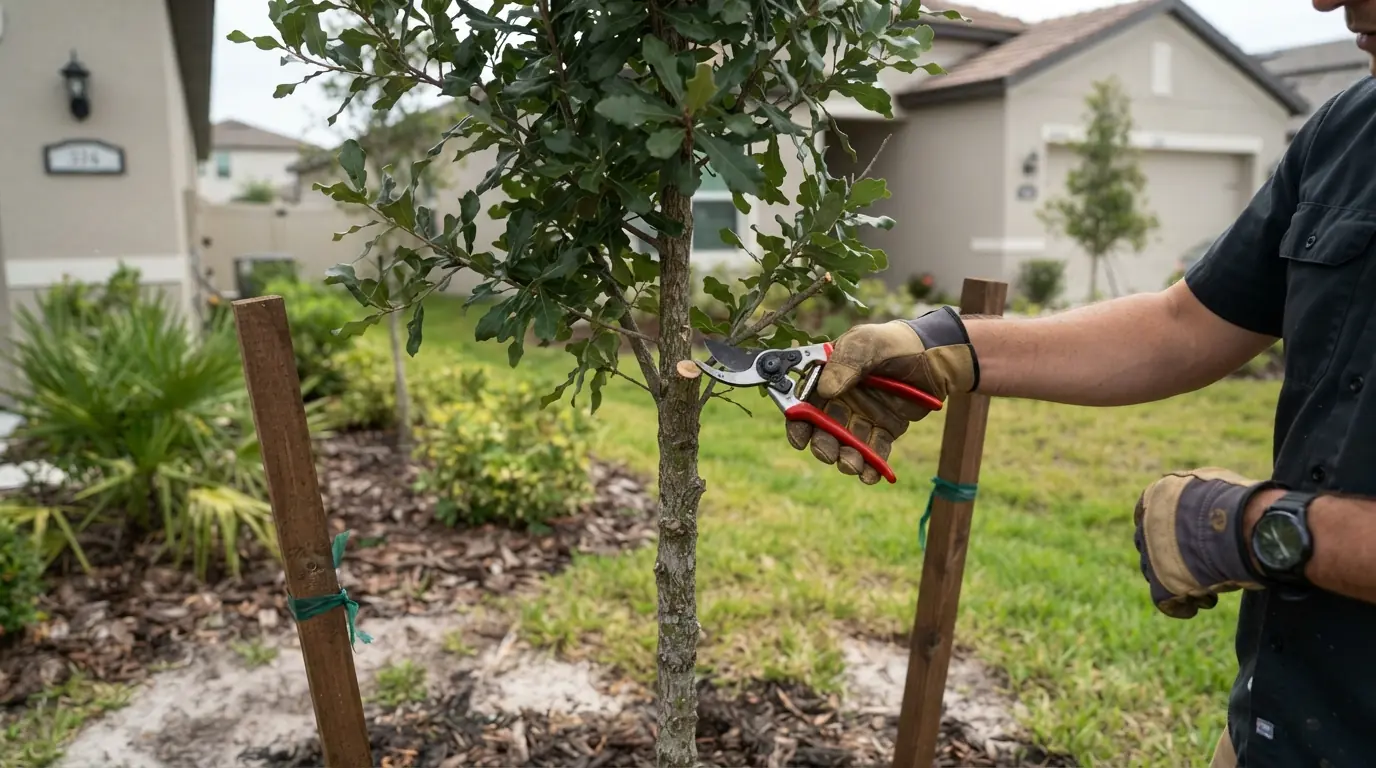
Training cuts are small, selective cuts on a young shade tree that steer its growth. We remove or shorten branches that cross, rub, grow back into the crown or compete with the main trunk, and we leave most of the foliage in place because a young tree needs its leaves to grow. Cuts are made with hand pruners or a small saw at the branch collar, and each one is planned against how the tree should look in twenty years.
Single-leader development
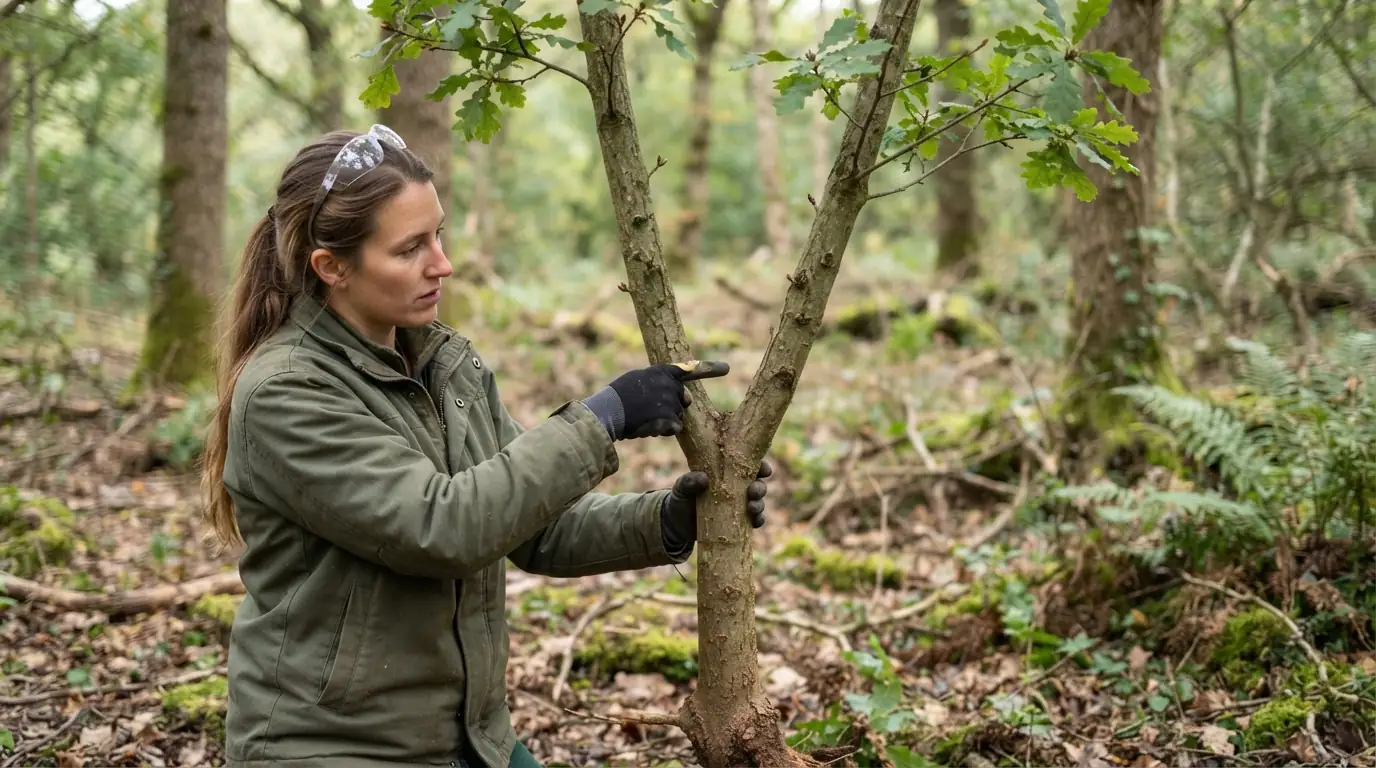
Most shade trees are strongest with one central trunk, called the leader, running up through the crown. When two stems of similar size compete, one is shortened so the other becomes dominant, and the shortened stem slows down and eventually becomes a normal branch. It is a gentle correction done over a few visits, not in a single cut. Left alone, those two stems grow into a weak V-shaped fork with bark trapped between them, the classic split we see after a storm.
Co-dominant stem correction
Co-dominant stems are the defect we see most in young trees, and the one that causes the most expensive problems later. The earlier they are corrected, the smaller the cut and the less it affects the tree. On a young live oak or maple, shortening one stem by a third to a half is usually enough to tip the balance. On older trees the same fix may need cabling instead, which is why young trees are worth checking every couple of years.
Clearance planning for growing trees
A young tree planted near a driveway, sidewalk or house will someday need clearance. Structural pruning plans for that early by choosing which branches will become the permanent lower limbs, set high enough to clear what will pass underneath, and gradually removing the temporary low branches as the trunk thickens. Raising a crown this way over years avoids the large wounds that come from cutting big low limbs off a mature tree decades later, when they are much harder for it to seal.
Why young trees matter so much in Tampa now
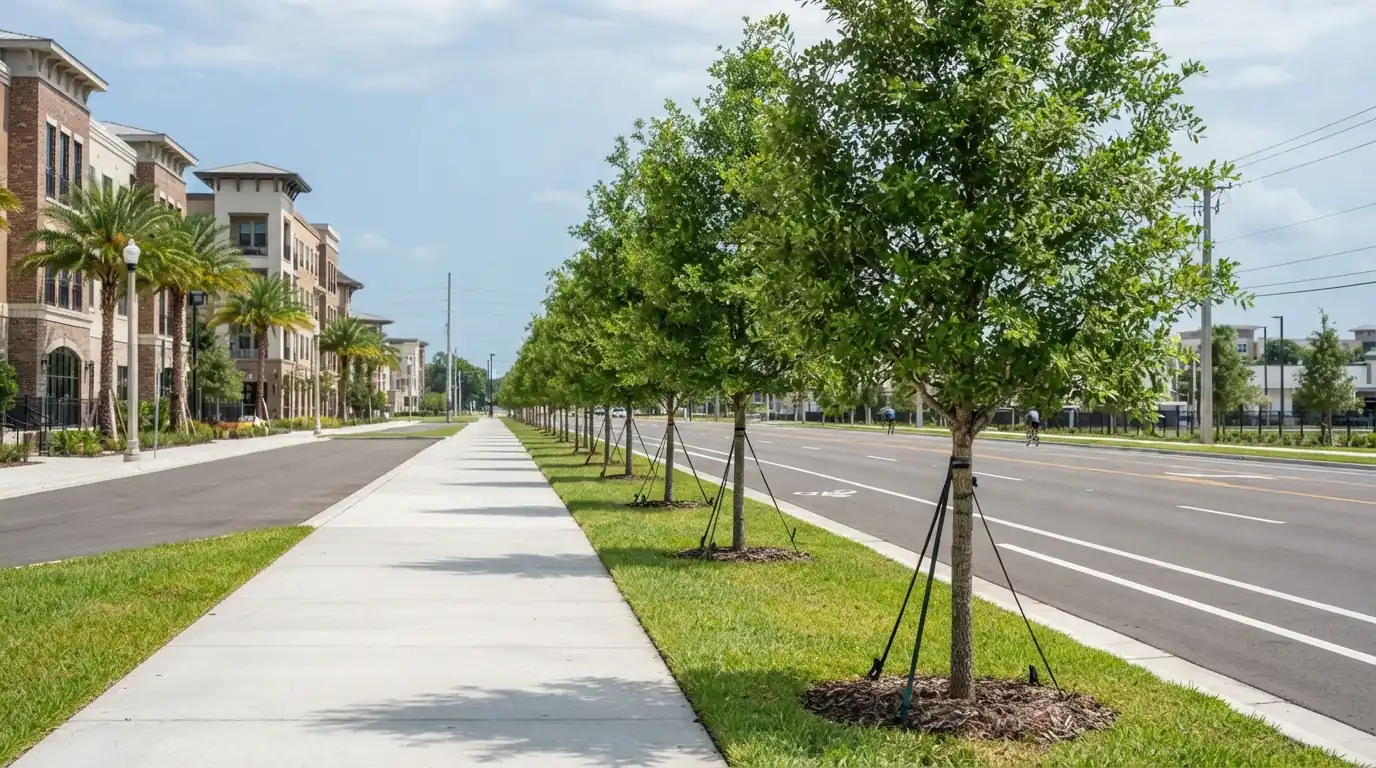
USF researchers found the 2024 storms cost Tampa nearly 5 percent of its canopy, with South Tampa and East Tampa losing the most, and recently planted trees were especially vulnerable because their roots had not spread yet. Much of that canopy is now being replanted. The young trees going in today will be the city's shade for decades, and how they are pruned in their first years decides how well they handle future storms.
Young tree or mature tree pruning?
| Factor | Young tree | Mature tree |
|---|---|---|
| Size of cuts | Small, finger to wrist thick | Often large limbs |
| Goal | Build structure | Maintain and reduce risk |
| Fixing a weak fork | Shorten one stem | Often cabling or bracing |
How a young tree visit runs
- 1Call
Tell us how many young trees and their age.
- 2Look
Leader, forks and low limbs checked.
- 3Plan
Which stems to keep and which to shorten.
- 4Prune
Small cuts at the branch collar.
- 5Stakes
Checked, loosened or removed.
- 6Notes
What to correct next time.
- 7Schedule
Next visit in two to three years.
What young tree pruning costs
There is no reliable published range for young tree pruning in Tampa; it is usually a quick visit priced per tree.
- Number of treesSeveral young trees in one visit.
- Tree sizeSmaller trees take minutes.
- DefectsCompeting stems take planning.
- StakesRemoval or adjustment.
- AccessRarely an issue.
- Follow-upVisits every few years.
Young tree pruning questions
Usually two to three years after planting, once it has settled in.
A light structural pruning every two to three years.
Not with light cuts; it directs growth instead.
Two trunks of similar size competing from one fork.
Small cuts yes, but choosing which stem to keep takes experience.
Yes, once the tree stands on its own, usually within a year.
Yes. Well-structured trees break far less often.
More trimming work
From our guides: Laurel Oak or Live Oak? How to Tell in Tampa